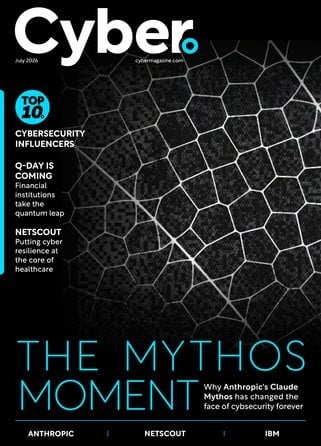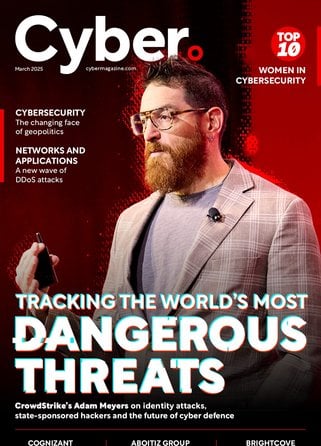
This Week's Top Five Stories in Cyber

Cloud Next 2026: Agentic AI Defence with Google Cloud
Google Cloud Next 2026, held in Las Vegas, delivered significant developments for security teams, with Google Cloud unveiling new defensive capabilities designed to counter AI-powered threats.
The announcements signal a major shift towards autonomous security operations, with AI agents now taking on advanced threat hunting and detection engineering roles.
Thomas Kurian, CEO of Google Cloud, reflects on the company's trajectory in his keynote: "When we gathered at Next a year ago, we talked about how genAI was transforming organisations around the world.
"Today, that future is in-production – the Agentic Enterprise is real – and deployed at a scale the world has never before seen."
Over the past year, Google Cloud has rapidly scaled its AI infrastructure and services, reflecting rising demand from organisations deploying advanced machine learning tools.
Beyond Passwords: Yubico’s Take on Post-Quantum Security
Good news to those exhausted by password fatigue, this way of authentication is quickly becoming an instrument of the past, thanks to their ability to being compromised quite easily. Or as the saying goes: "Attackers don't hack in, they log in."
Taking away that age old trick from toolbox of bad actors, emerges the era of passkeys and hardware security keys which requires verifying both possession and intent.
With AI in the mix, gone are the days when phishing emails contained grammar or spelling mistakes that made them easy to spot, thereby ushering in an age where phishing-resistant logins are necessary.
Further complicating the security issue, the quantum clock is ticking down. There will come a time when quantum computers will be powerful enough to break current encryption standards. This necessitates preparation for the move towards post-quantum cryptography.
Speaking with Cyber Magazine, Nic Sarginson, Principal Product Manager at Yubico, explains the nitty gritty behind these major security movements.
Cyber Essentials: What Enterprises Need to do for Compliance
The UK’s Cyber Essentials scheme, rolling out this week, is the latest edition of the guidelines that sets the baseline for the nation’s cyber resilience.
Developed with the National Cyber Security Centre and delivered by the IASME Consortium, the guidelines follow the major cyber developments, with the framework is reviewed each year using audit data, breach analysis and assessor feedback.
This year, the five core controls in the scheme remain unchanged, with the latest revisions focusing on improving clarity, consistency and assurance.
For organisations preparing to receive the Cyber Essentials certification or renewal, the emphasis is now firmly on accurate implementation and verifiable outcomes rather than interpretation.
“The biggest benefit of adopting Cyber Essentials is building resilience against attacks that exploit weak or missing protections,” says Kirsty Paine, Field CTO and Strategic Advisor at Splunk.

How Dell PowerMaxOS 10.4 Bakes in Ransomware Resilience
Organisations today face mounting pressure to strengthen their cyber defences while modernising infrastructure – all while navigating an increasingly complex threat landscape where a single vulnerability means business-critical disruption.
In this environment, Dell Technologies has introduced PowerMaxOS 10.4, a significant evolution in its mission-critical storage portfolio.
Designed to deliver stronger cyber resilience, enhanced threat protection and robust compliance capabilities alongside performance improvements, the release reflects the growing need for infrastructure that can defend against modern cyber risks while supporting business continuity.
As John Roese, Global CTO and Chief AI Officer at Dell Technologies, says: "AI infrastructure isn't just traditional IT with a GPU bolted on – it's a fundamentally different architecture from the ground up.
Cyber Breaches Survey: Phishing & Supply Chain Risks Soar
Cyber attacks wreak havoc in a significant share of UK organisations, with the latest Cyber Breaches Survey revealing that 43% of businesses and 28% of charities reported having experienced a breach or attack in the past year.
Commissioned by the Department for Science, Innovation and Technology (DSIT) and the Home Office, the survey helps us understand the clutch of cyber threats on UK organisations and their level of preparedness.
The lion’s share of attacks are focussed on the larger organisations.
Around 69% of large businesses and 65% of medium-sized firms reported incidents, compared with 46% of small businesses and 42% of micro organisations.
Encouragingly, senior leadership attention is holding steady.
Company portals




Executives

John Roese
Chief AI Officer
Kirsty Paine
Field CTO & Strategic Advisor

Nic Sarginson
Principal Product Manager

Thomas Kurian
CEO