Cybersecurity requires a multifaceted and in-depth approach that covers all aspects of an organisation’s operations, training and processes to protect properly. And just as important as tools, technologies and applications are in closing the door to potential attackers, cybersecurity certifications play an important role.
They validate the skills and knowledge within the business when it comes to protecting systems and data, ensuring a skilled workforce capable of defending against evolving threats.
Certifications also demonstrate a commitment to best practices and standards, enhancing the organisation's security posture and providing important trust signals to customers and partners. In some industries, certifications are required for regulatory compliance, avoiding penalties and legal issues.
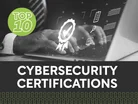
By investing in cybersecurity certifications, enterprises create a culture of security awareness and expertise. Here are the top 10 enterprise cybersecurity certifications to consider.
10: Certified in Risk and Information Systems Control (CRISC)

Offered by ISACA, CRISC validates expertise in identifying, evaluating, assessing and mitigating IT risks. It covers four key domains: IT Risk Identification, IT Risk Assessment, Risk Response and Mitigation, and Risk Monitoring and Reporting, and is focused on the design, implementation, monitoring and maintenance of information systems controls. CRISC helps cyber professionals understand the relationship between IT risk and business objectives, leading to more effective risk management strategies and better protection of essential enterprise information assets.
9: Systems Security Certified Practitioner (SSCP)

SSCP is offered by ISC2 and validates foundational knowledge and skills in implementing, managing, and maintaining IT security. It's a globally recognised credential demonstrating competence in operational security and covers seven key domains. These are: Security Administration; Access Control; Identification, Authentication, and Authorisation; Auditing and Monitoring; Risk, Response, and Recovery; Cryptography; and Data Security. This certification is centred around hands-on application of skills rather than high-level strategy and is for roles such as security analyst, systems administrator or network technician.
8: Offensive Security Certified Professional (OSCP)

An ethical hacking certification that validates skills, knowledge and expertise in penetration testing. OSCP training covers a broad scope of themes including information gathering, vulnerability scanning, exploit development, privilege escalation and report writing. Its focus is hands-on application and the certification is well known for its 24-hour practical exam in which candidates must compromise multiple systems in a simulated network environment. Certified professionals help keep enterprises secure by proactively identifying and exploiting vulnerabilities in their systems.
7: Certified Cloud Security Professional (CCSP)

Increased adoption of cloud services has made certifications like CCSP an indispensable part of the enterprise security environment. Offered by ISC2 and globally recognised, the certification validates skills and expertise in designing, implementing, managing and securing data and applications in the cloud. It covers six key domains including Cloud Concepts, Architecture and Cloud Data Security, and addresses areas like infrastructure protection and compliance with regulations. Crucially for businesses, it provides understanding of the unique security challenges inherent in cloud computing.
6: GIAC Security Essentials (GSEC)

GSEC is designed for individuals looking to demonstrate their foundational understanding of information security concepts and practices. It's designed for IT professionals requiring a broad knowledge of security principles, rather than specialising in one area and covers key areas like security management, network security, host security, data security, and security awareness. By establishing a baseline of security knowledge, the GSEC contributes to a more secure and aware workforce, reducing vulnerabilities and improving the overall security posture of the enterprise.
5: Certified Information Systems Auditor (CISA)

Offered by ISACA, CISA is a globally recognised certification for those specialising in IT audit, control and security. It validates expertise in assessing and improving an organisation's IT and business systems. The credential covers five key domains: Information Systems Auditing Process, Governance and Management of IT, Information Systems Acquisition, Development, and Implementation, Information Systems Operations and Business Resilience, and Protection of Information Assets. Certified professionals are critical to enterprise security and can help compliance with regulations, protect sensitive data, and maintain business continuity
4: Certified Information Security Manager (CISM)

This ISACA certification is centred around aligning security initiatives with business objectives, boosting security through a more strategic focus on areas like ensuring security controls are in place to protect information assets, manage risks effectively and respond to security incidents appropriately. By focusing on management and strategy, CISM certification develops the skills to lead and direct information security efforts. This is essential for ensuring security is integrated into all aspects of the business, ultimately contributing to a more secure and resilient enterprise.
3: CompTIA Security+

This entry-level certification covers fundamental concepts of risk management and incident response, making it suitable for those new to cybersecurity. It’s globally recognised as important for establishing many of the essential baseline skills needed for a career in IT security and is vendor-neutral to give a broad understanding of security concepts and best practices. Its scope is wide, but covers areas including Attacks, Threats and Vulnerabilities; Architecture and Design Best Practice; Operations and Incident Response; and Governance, Risk and Compliance.
2: Certified Ethical Hacker (CEH)

CEH is all about offensive cybersecurity. It’s a globally recognised certification offered by the EC-Council, the world’s largest cybersecurity technical certification body, and validates the skills and knowledge needed to think like a hacker and identify vulnerabilities before malicious actors can exploit them.
The CEH covers a wide range of ethical hacking domains from Footprinting and Reconnaissance, Scanning Networks and Vulnerability Analysis through to Social Engineering, Cloud Computing Security and more. The objective is to help professionals understand the tactics and techniques used by malicious hackers so as to effectively defend against cyberattacks and strengthen the overall security posture of enterprises.
CEH-certified individuals help keep enterprises safe by proactively identifying vulnerabilities, improving security posture, developing secure coding practices and responding to security incidents.
1: Certified Information Systems Security Professional (CISSP)

Offered by ISC2, CISSP is considered by many to be the gold standard in cybersecurity certification and is widely recognised as a demonstration of expertise in the field. Many organisations, particularly larger enterprises or government agencies, specifically require or prefer CISSP-certified professionals when hiring for leadership positions.
Its focus is largely strategic, providing the capabilities to design, implement and manage an organisation’s overall security posture. As well as technical skills, it also ensures a more holistic approach to security to take in themes such as management, risk assessment and the intricacies of legal and regulatory compliance.
CISSP’s Common Body of Knowledge covers eight domains: Security and Risk Management; Asset Security; Security Architecture and Engineering; Communication and Network Security; Identity and Access Management (IAM); Security Assessment and Testing; Security Operations; and Software Development Security.
Explore the latest edition of Cyber Magazine and be part of the conversation at our global conference series, Tech & AI LIVE and Cyber LIVE.
Discover all our upcoming events and secure your tickets today.
Cyber Magazine is a BizClik brand